

Written by Caitlin Havener Rogers — Certified Precision Nutrition Coach
Share This

Pages on this site may contain affiliate links, meaning if you book or buy something, I may earn an affiliate commission at no additional cost to you. Thank you for your support! Learn More
Also note: While I am a certified nutrition coach, I am not a medical doctor. Information here is not intended to be a replacement for the advice you should seek from your doctor.
Here’s something I figured out after years of cooking for seven: most of the time dinner takes isn’t the cooking. It’s the looking. Looking for the cumin. Looking for the good knife. Looking for the lid that goes with the pot that someone put away wet.
So if you want to know how to cook faster, start there. You don’t need fancy skills or a kitchen remodel. You need a few simple kitchen hacks: things where you can find them, chopping habits that save real minutes, and a couple of appliances doing the jobs you shouldn’t be standing over.
Here’s how I do all three, a little at a time.
Tired of ads while you cook? Go ad-free for a one-time $5.
1. Organization Hacks: A Little at a Time
I’m not going to tell you to empty every cabinet this weekend. I have five kids. That’s not happening at my house, and I’m guessing it’s not happening at yours either.
Instead, pick one small zone a week. Fifteen minutes, done. Here’s the order I’d go in, because each one saves time the very next night.
Week 1: Build a dinner zone by the stove
Put the things you reach for every single night within arm’s reach of the stove: oil, salt, pepper, and your five most-used spices. For a lot of families that’s something like cumin, garlic powder, chili powder, paprika and an Italian blend. Everything else can live in the cabinet. This one change stops the nightly spice hunt.
Week 2: Grab bins in the pantry
Group like with like in open bins: one for canned beans, one for grains and pasta, one for sauces and broth. You grab the bin, not the can. When I talk about pantry essentials, these are the bins they live in.
❤️❤️ Don’t miss a recipe or post! Make sure you remember to sign up for my Newsletter and follow me on social ❤️❤️!
Get Your Free Stuff!


Week 3: One fridge shelf for prepped food
Clear one shelf at eye level and keep it for anything already washed, chopped or cooked. When it’s all in one place, you actually use it before it goes bad.
Week 4: The freezer file
Freeze food flat in labeled bags and stand them up like files. You can see everything at a glance. I walk through the whole method, plus a free printable chart, in my vegetarian freezer meals post.
One more thing: label the shelves and bins. It won’t stop the kids from putting the peanut butter back in the wrong spot, but at least now there’s a right spot to point to.
2. How to Chop Vegetables Fast
Most of us were never actually taught to chop. We picked it up by watching someone else and hoping for the best. A few habits make a bigger difference than any gadget.
The basics that matter most
- Use a sharp knife. A sharp knife is faster and safer, because it cuts instead of slipping. I have used my Tojiro chef’s knife for most of my chopping for years.
- Use the claw grip. Curl the fingertips of your holding hand under, so your knuckles guide the blade. Your fingertips stay out of the way, and you can chop faster without watching every cut.
- Make a flat side first. Cut a thin slice off round vegetables like onions, potatoes and carrots so they sit flat and don’t roll.
- Cut pieces the same size. Same-size pieces cook evenly, so nothing is burnt while something else is still raw.
What pros do that most of us were never taught
- Put a damp towel under your cutting board. It stops the board from sliding, which is half the battle.
- Rock chop herbs and garlic. Keep the tip of the knife on the board and rock the handle up and down. It’s much faster than lifting the whole knife for every cut.
- Scoop with the back of the knife, not the edge. Scraping food across the board with the sharp edge dulls it. Flip the knife over, or use a bench scraper.
- Skip the horizontal cuts on onions. America’s Test Kitchen has a “leapfrog” method that dices an onion without any sideways cuts toward your hand.
- Cut peppers around the core. Stand the pepper up and slice the four sides off the core. The seeds stay behind in one piece.
- Set everything out before you turn on the stove. Chefs call it mise en place. Chop all your same-shape cuts together, then cook without stopping to dig for the next ingredient.
Work smarter, not harder
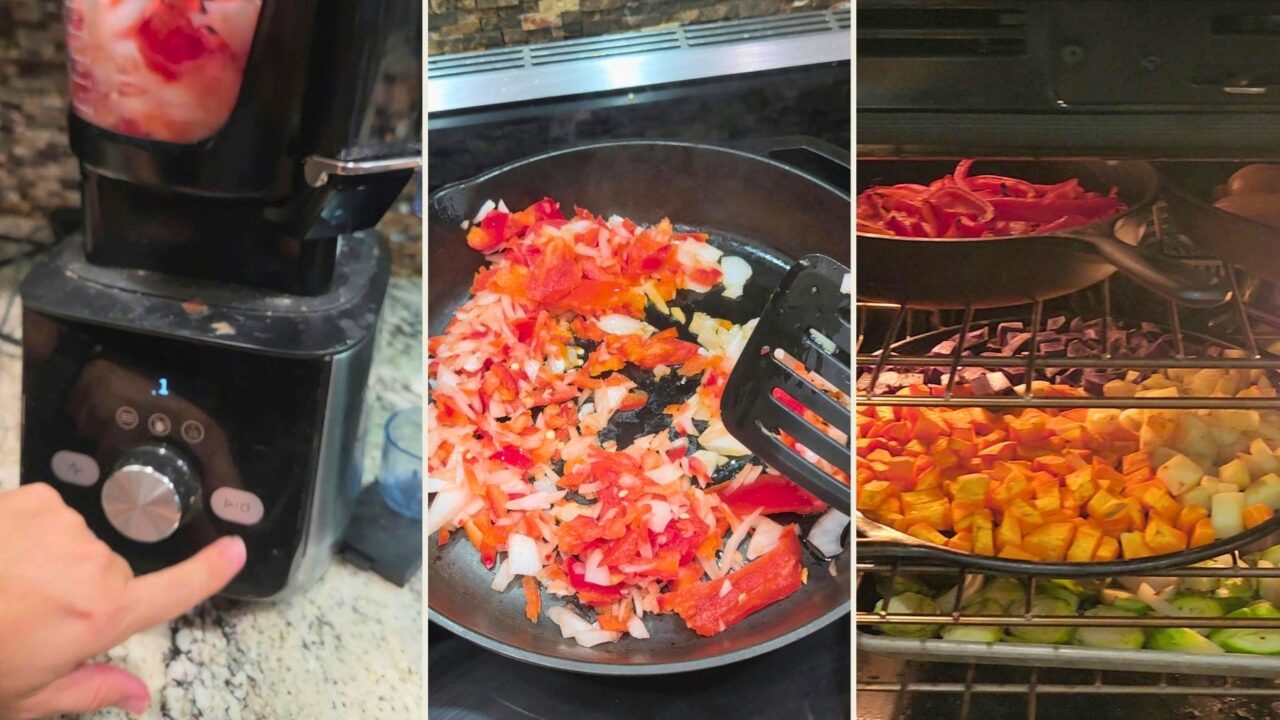
- Chop for two meals at once. If you’re already dicing an onion, dice two. Use half tonight and freeze the rest raw in a flat bag for next time. Chopped onions and peppers go straight from the freezer into the pan.
- Keep a scrap bowl on the counter. One trip to the trash or compost instead of ten.
And sometimes the fastest chop is no chop. Pre-chopped onions, shredded cabbage, bagged spinach and frozen vegetables are all fair game on a crazy week. That’s not cheating. That’s dinner.
3. Appliance Hacks: Let Machines Do the Heavy Lifting
These are the three I actually use, and why they save me time. (Some of these are affiliate links, which means I may earn a small commission at no extra cost to you.)
A high-speed blender for sauces, soups and smoothies
My Vitamix Ascent X5 is the blender I use every day. One sauce can change a whole week of meals, and a high-speed blender makes a smooth sauce or smoothie in a minute or two, and even hot soup in a few minutes. The food processor attachment shreds carrots and cabbage in seconds, which beats a box grater any day. If you’re shopping, I keep a running list of the current Vitamix deals.
A pressure cooker for beans and grains
My Instant Pot Duo (6 quart) cooks dried beans without an overnight soak, and it cooks rice and lentils while I’m off doing ten other things. It’s also behind a lot of my soups, like this butternut squash lentil soup and these lentil sloppy joes.
An air fryer for fast roasted vegetables
My Instant Vortex air fryer crisps vegetables with only a quick preheat instead of waiting on the big oven. It’s how I make crispy buffalo cauliflower and air fryer falafel on weeknights.
Put It Together: The Faster Dinner Formula
Everything above feeds one simple routine: find it fast, chop it once, let a machine do the waiting, and add one fresh thing at the end.
This is one chapter of my Family Chaos Meal System: Prep, Sauce, Combine, Repeat. It’s built for families with no time, no patience for perfection and at least one kid who treats broccoli like a personal insult. Faster prep is how the whole system fits into a real weeknight.
How to Cook Faster: FAQ
What is the fastest way to get better at cooking quickly?
Start with organization, not speed. When your everyday ingredients and tools are in the same place every night, you save more time than any knife skill will.
How can I chop vegetables faster without cutting myself?
Use a sharp knife, the claw grip, and give round vegetables a flat side before you start. Speed comes from a steady rhythm, not from rushing.
Is buying pre-chopped vegetables worth it?
On busy weeks, yes. It costs a little more, but if it’s the difference between cooking at home and ordering takeout, it’s worth it.
Which kitchen appliance saves the most time?
It depends on what you cook most. For beans, grains and soups, a pressure cooker. For sauces and smoothies, a high-speed blender. For roasted vegetables, an air fryer.
Please show your support! ❤️
- Let us know how the recipe went in the comments.
- Share a picture or video of what you made on social - tag @cleancookingcaitlin.
- Pin this on Pinterest by hovering over any of the images!
- Share with a friend!


Latest Posts
Quick Vegetarian Dinners: Store-Bought Shortcuts for Busy Families
How to Cook Faster: Easy Kitchen Hacks for Busy Families (Organization, Chopping and Appliances)
Vegetarian Freezer Meals for Families (No Meal Prep Day Needed)